Poster at the 43rd annual European Conference on Visual Perception (ECVP)
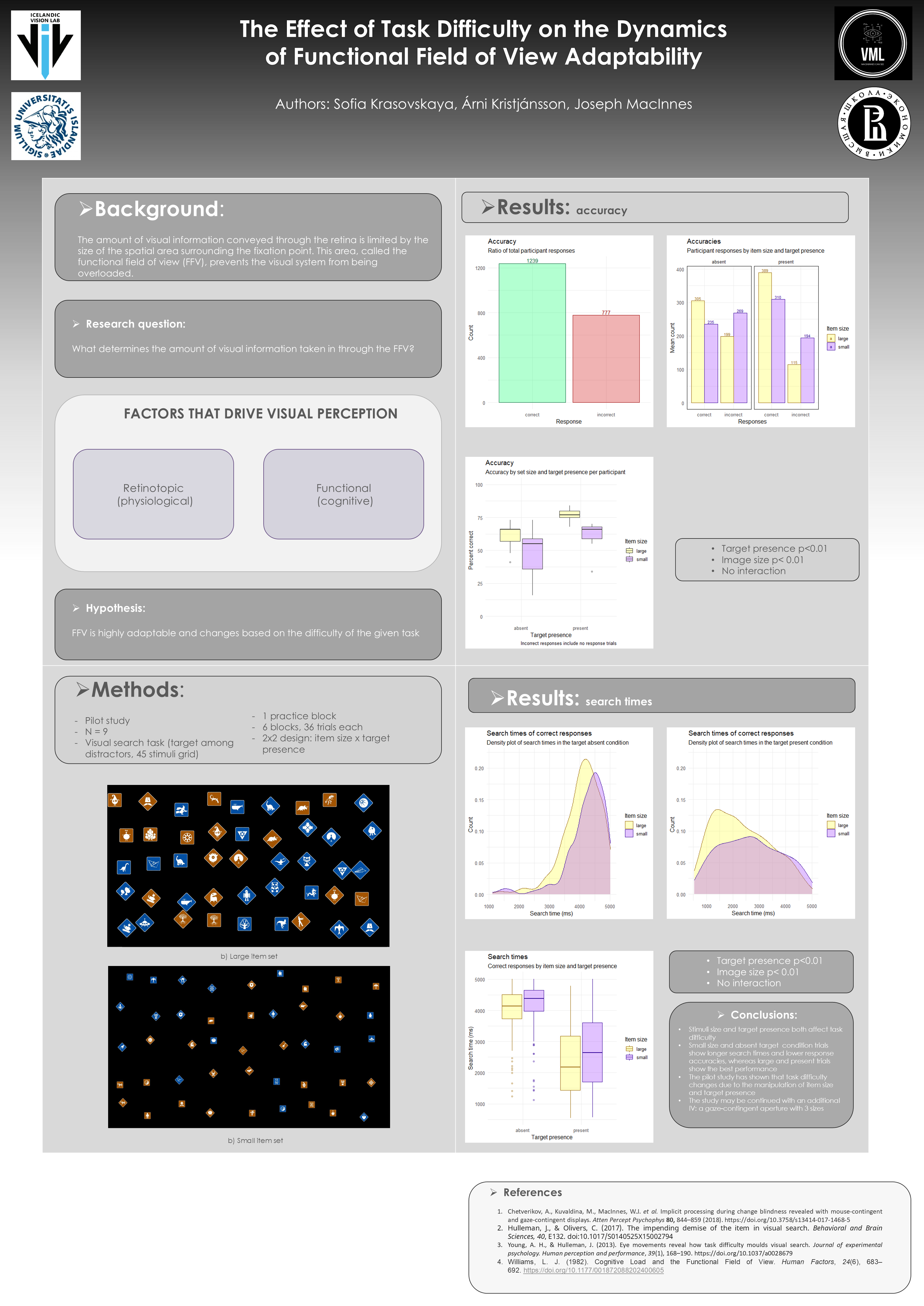
Title: The Effect of Task Difficulty on the Dynamics of Functional Field of View Adaptability
The amount of visual information conveyed through the retina is limited by the size of the spatial area surrounding the fixation point. This area, called the functional field of view (FFV), prevents the visual system from being overloaded. The size of the FFV is determined by two types of factors that drive visual perception, namely, the retinotopic (physiological) and the functional (cognitive) factors. One hypothesis is that the FFV is highly adaptable and changes based on the difficulty of the given task (Young & Hulleman, 2013), shrinking in response to high task demands and expanding during the execution of easier tasks. In order to investigate the dynamics of FFV adaptability, we propose a gaze-contingent experiment that would allow us to manipulate the FFV in a controlled visual search paradigm. Participants (N=15) search for either a large (5-7°) or a small (1-3°) target among a set of same-size distractors in three difficulty conditions based on the size of the gaze-contingent aperture: a small aperture (2°) for the difficult condition, a medium-sized aperture (5°) for the average condition and a large aperture (8°) for the easy condition. We hypothesize that the results will show the analysis of response times and accuracies in each of the search conditions given both target sizes using a repeated measures ANOVA, as well as the interactions between them. [This work is partially supported by the HSE academic fund program for the scientific research lab “Vision Modelling Lab”]

Sofia Krasovskaya
Cognitive Neuroscientist
Cognitive scientist interested in all things vision, perception and attention.